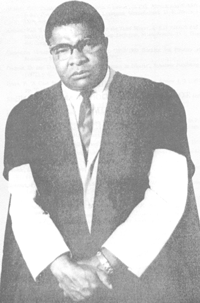
The Enemies Of African Unity
By Bernard Fonlon (An Extract from "Task Of Today", March, 1966)
The idea that African unity is unrealistic, impossible, a pipe dream; that those who call for an all-African, continental government are crying for the moon, is European-inspired.
For, since the white man has kept black men under, by keeping them divided, it is the most natural thing in the world that he should become the sworn enemy of African unity, since such unity constitutes a formidable threat to his hegemony.


1. Twenty years ago, on 26th August 1986, Bernard Nsokika Fonlon died in Canada. He had gone there in the month of May of that year in order to receive a doctorate degree in Literature (D. Litt.) from the University of Guelph, and it was his intention to spend the 1986/1987 academic year in the United States of America, within the framework of a Fulbright programme. But the Lord, the Giver of Life, decided otherwise. Bernard died in Canada at the age of sixty-one years, and nine months and six days. He would have been sixty-two years of age on 19th November 1986.
WILLIAM FULBRIGHT has argued that literary agitation, like practical political instigation, which edges on dissent or rebellion is “an act of faith”. Accordingly, and, as I have already shown elsewhere, although Professor Bernard Nsokika Fonlon (a man who was so exceptionally handsome), was, an intellectual pillar of fire; a Prometheus among his peers; indeed, something of a twentieth century Aristotle, the Greek philosopher and classical biologist, his neo-classical treatise on literary composition have, neither,received accolades nor endorsement from me.
As a primary school pupil in the former West Cameroon and precisely at St.Joseph's Catholic Boy's School Bamenda in the early 1970's, my teacher introduced the concept of Ph.D to us. He further stressed that Dr. Bernard Fonlon was one of the first Cameroonians to obtain one. The concept stuck and I nursed ambitions or fantasized about doctorate degrees!
It's a rainy and soggy morning in the city of Douala. The day is the 26th; the month is August; the year is 1992. For several days now, endless garlands of words have been winding their way through my mind as I reflect on a fitting tribute to pay my Master, the Yaounde University Professor Emeritus, Doctor Bernard Nsokika Fonlon, of glorious memory. But, somehow those words have failed to deflower the virgin sheet of paper before me.
Africans celebrate life. In fact, someone has said that Africans have a cultural instinct for celebration; and this is true to experience and fact. When a child is born, we celebrate his coming into the world; when he is initiated, we celebrate his new status; when he marries we celebrate his maturity and when he dies we celebrate his transition into the sublime world of the Ancestors. If we fondly remember Bernard Nso’kika Fonlon, it is partly due to the fact that he has gone before us marked with the faith of our ancestors.

The tributes to Fonlon contained in this section titled ALA Bulletin Tributes were originally published in the African Literature Association (ALA) Bulletin, Volume 12, Number 3 of Summer 1986, just months after the death of Bernard Fonlon. They are from some of the people who knew him best and/or worked closely with him on numerous projects.
In 1964, barely three years after the unification of the British Southern Cameroons and the French Cameroons and the creation of the Federal Republic of Cameroon, cracks began appearing in the edifice. Dr. Bernard Fonlon, then Chief scribe of the K.N.D.P. (the ruling party in the former Southern Cameroons), wrote a secret letter to President Ahidjo informing him that the KNDP was disillusioned with its marginalization within the federation.
By Francis K. Wache
The following is an interview Martin K. Jumbam conducted on July 19, 1987 in Douala with Dr Stephen Arnold, then Professor of Comparative Literature and Vice-Dean for Graduate Studies and Research at Canada’s second largest university, the University of Alberta in Edmonton [now retired]. A scholar of African literature with a world-wide reputation, Dr. Arnold has written many articles on Cameroon’s literatures in English and French. He is also the Editor of the quarterly African Literature Association Bulletin.
Recent Comments